Web Copywriting, SEO and the Web at Large

Technology video: Did you know?

Posted March 30, 2009 | Posted By Rick Sloboda
Categories: Web world at large | 1 Comment | Share This


We came across a compelling video that makes you reflect on where we’re headed with technology, and just how fast.

Some of the gripping facts:

  • The top 10 in-demand jobs in 2010 did not exist in 2004

  • 1 out of 8 couples married in the US last year met online

  • If MySpace were a country, it would be the fifth-largest in the world

In the end, the video asks: What does it all mean? Perhaps if we don’t fully embrace technology, we’ll literally be left in the dust – sooner than later.

Check it out right here, right now.

Playing in Google’s Sandbox

Posted March 25, 2009 | Posted By Rick Sloboda
Categories: Website promotions | 1 Comment | Share This


Owners of new websites often ask about the Google sandbox, a filter the search engine uses to fight spam.

Google typically indexes a new website, lists it for a few search terms and then the web pages drop from the search engine result pages for some months.

Generally, brand new websites with new domain names need about six to eight months to get top rankings on Google.

How do you get out of the Google sandbox?

While some waiting is required, you can prompt Google to speed up the process.

When you register a new domain name, create a temporary page immediately as the six- to eight-month delay appears to start with Google’s first contact with your web site. The sooner Google knows about your web site, the better.

Also, ensure you acquire some quality inbound links from other websites, and get your meta data optimized. The meta data, which comprises title, keyword and description tags, can make a big difference. In fact, this factor has helped some Webcopyplus clients attain desired rankings in as little as six weeks.

So get a page or two up as soon as you can, and take your links and keywords seriously. It can make a world of difference to your new website’s search engine rankings and online presence.

Putting social media to work

Posted March 19, 2009 | Posted By Rick Sloboda
Categories: Web world at large, Website promotions | 4 Comments | Share This


The recession has put major pressure on marketers to deliver results, and many are responding by increasing investments on social marketing. The reason?

Social media provides relatively inexpensive tools that can quickly get marketing messages out through interactive discussion and rapid word of mouth.

But how does a business go about making social applications a permanent part of its marketing efforts?

Plan for success

According to James Wallace of Kontent Creative, a Vancouver design studio and web development group that helps clients tap into the social media realm, there needs to be a cohesive company strategy in place for social media interaction.

This helps ensure your company message is consistent through all channels, he explained, whether you’re tapping into Twitter, the company blog, Facebook, LinkedIn, or any of the other many social media sites.

To establish the inherent value of the online networks you are connected to, Wallace said you need to ask yourself:

  • Do these networks support collaboration?
  • Can your users/followers/friends share information amongst each other?
  • Can they share information with your organization?

This type of free-flowing collaboration is key to user interaction and engagement.

The new media model

Wallace stressed that social media platforms derive their value from both the collective and the individual at the same time – not from the masses.

“This is a reversal of the traditional, single message, mass marketing pushes of the past,” he said. “In this realm, it isn’t necessarily about the content anymore, but how you connect the customer or client to the content and the conversations that ensue.”

It’s these types of conversations, he noted, that garner the most value or insight into how your organization is perceived in the marketplace.

It’s about “we” not “me”

Participation is mandatory, insisted Wallace. “Any socially driven effort needs to be participatory,” he said. “Failing to do so provides no consumer or client trust in these closely monitored relationships.”

He said organizations need to look at the Web differently, suggesting: “The concept of the Internet as ‘property’ is over.

“The tech-savvy Millennials and Generation Y have considerable online clout and have begun to move into the marketplace with vast buying power,” said Wallace. “Collaborative and participatory media in all its forms that passes from one platform to another, seamlessly, is the expectation of these consumers.

“Millennials want to read it online via laptop, post it from their iPhone, stream it from their BlackBerry and then SMS the link to Twitter,” he added. “The mindset is a ‘we’ not ‘me’ view and the door is open to collaborative, fully-shared online environments that fall outside of traditional marketing circles.”

Steps to social media success

Kontent Creative shared these steps to fully leverage social media, in a bid to build meaningful relationships that gain access and acceptance within your market community:

  1. Start small with one platform – Twitter, Facebook, LinkedIn.

  2. Listen to what people are saying on social networks and determine what value your organization can add.

  3. Have a strategy – this will determine the time, internally, that is spent on social media applications and will dictate the focus of engagement. A strategic plan is the single most important key to effective engagement.

  4. Engage within your chosen platform and commit to establishing relationships. Abandoned or ignored relationships foster mistrust. Note: Posting rules need to be defined – a social media policy for company engagement should be established and agreed on.

  5. Step away from the machines. Social media applications do well to foster conversations, however, nothing can replace eye-to-eye conversations. Attend real world events and put a face to the posts.

  6. Measure your success on an established timeline basis weekly or monthly. Solid business relationships are not built on a mouse click. Ask yourself: Did we learn from our customer/client interactions? Did our client/customer learn something about the organization? Was there true and valued engagement?

Kontent Creative is a Vancouver-based design studio and web development firm that provides organizations a full spectrum of branding and marketing services.

Search Engine Optimization: Don’t Deceive

Posted March 18, 2009 | Posted By Rick Sloboda
Categories: Website promotions | 2 Comments | Share This


Despite the perception of so many business owners, search engine optimization is not about tricking search engines to get anyone and everyone to your website.

It’s about building an effective online marketing strategy that delivers a flow of highly targeted prospects who are seeking what you offer.

Yet, so many business owners think more traffic – any traffic — is the key to their success on the Web. Sure, it looks impressive when reviewing Google Analytics. But the wrong traffic will do little for a company’s bottom line.

For more insight, read Good traffic, bad traffic.

Web content headlines: Tell visitors where they are

Posted March 17, 2009 | Posted By Rick Sloboda
Categories: Writing for the Web | 2 Comments | Share This


Your website’s headlines and kickers (a.k.a. sub headlines) need to tell visitors they’re in the right place.

You have a fraction of a second to orient people on the Web. If your web content does a good job, you’re often a step closer to a conversion. Miss the mark and your bounce rates will go through the roof.

A headline takes more than a catchy hook or angle to get prospects to stop and scan your web content. You need to align your headlines and web content with your visitors’ emotional drivers or trigger points.

The most effective way to achieve this is to leverage what you know about your target audience. Familiarity can help you nail the right information, keywords and angle.

But always be sure to provide practical information on where they’re at and what you can do for them. Vague statements don’t stick well on the Web. “5 Writing Tips for Web Designers” is a lot more helpful to visitors than a generic headline, such as “Writing and Web Design.”

Precise, practical headlines help your visitors get to the right information, and spare them time and frustration.

Relationships: Google reveals signs of the times

Posted | Posted By Rick Sloboda
Categories: Web world at large | 2 Comments | Share This


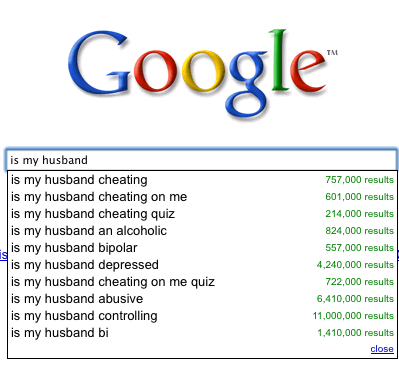
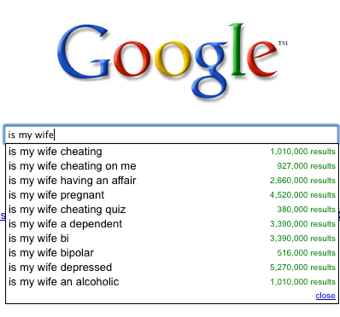
While conducting research for a dating site, one of our web writers came across these popular search terms in Google, reflecting the state of modern relationships (and perhaps society at large):

Webcopyplus web copywriter Google sample - Is my husband…

Webcopyplus web writer Google sample - Is my wife….

Long-term domain registration helps Google rankings

Posted March 16, 2009 | Posted By Rick Sloboda
Categories: Website promotions | 3 Comments | Share This


While it’s generally known within the SEO industry, few business owners are aware the amount of years you register your domain name impacts its search engine rankings.

Need to renew soon? Look at it as an opportunity.

The logic is based on the view that most spammy sites are fly-by-night operations. They show up, scam people, and disappear (either by choice or they get knocked of Google’s index). On the other hand, legitimate businesses plan on sticking around for a long time, and register domains accordingly. One of the reasons might be to ensure the domain name doesn’t lapse and become available on the open market.

Rest assured this isn’t a rumour. In fact, it’s documented in patent applications filed by Google. Here are some relevant claims taken directly from the patent #20050071741:

1. A method for scoring a document, comprising: identifying a document; obtaining one or more types of history data associated with the document; and generating a score for the document based on the one or more types of history data.

2. The method of claim 1, wherein the one or more types of history data includes information relating to an inception date; and wherein the generating a score includes: determining an inception date corresponding to the document, and scoring the document based, at least in part, on the inception date corresponding to the document.

38. The method of claim 1, wherein the one or more types of history data includes domain-related information corresponding to domains associated with documents; and wherein the generating a score includes: analyzing domain-related information corresponding to a domain associated with the document over time, and scoring the document based, at least in part, on a result of the analyzing.

99. Certain signals may be used to distinguish between illegitimate and legitimate domains. For example, domains can be renewed up to a period of 10 years. Valuable (legitimate) domains are often paid for several years in advance, while doorway (illegitimate) domains rarely are used for more than a year. Therefore, the date when a domain expires in the future can be used as a factor in predicting the legitimacy of a domain and, thus, the documents associated therewith.

The bottom line is if Google takes the registration period seriously, so should you. The next opportunity you have, register your domain for five or even 10 years, which is currently the max.

Web content: Who cares?

Posted March 14, 2009 | Posted By Rick Sloboda
Categories: Writing for the Web | 0 Comments | Share This


When you’re creating or revamping your web content, be sure to periodically ask yourself: “Does my audience care?”

If the answer is no, you’re headed down a slippery slope. That’s because web content should speak to and cater to the visitor – not the business owner, designer, developer, programmer, or your spouse. Indeed, the consumer is the true king of the Web.

To help achieve useful web content, you need to define not only what content will be published, but why you’re publishing it in the first place.

Self-centric jargon just gets in the way. Visitors want to know how you can help them. So tell them.

Don’t waste their time with we-driven copy. Respect your online guests.

Designer discusses how colours can impact a business

Posted March 13, 2009 | Posted By Rick Sloboda
Categories: Business & marketing, Web world at large | 2 Comments | Share This


The colours you choose to represent your business say a lot about you, suggests Juliette Schmerler of SPECTRAMEDIA Strategic Design Solutions.

“Politicians, fashion designers and brand managers pay serious attention to colour trends and colour psychology,” she said.

And so should you. After all, she explained, colour can play a large part in how your audience reacts to you. But be aware choice of colour isn’t just about personal preference.

“There are some colours that are rather obviously associated with particular industries, such as blue for water companies and green for environmental agencies,” noted Schmerler. “However, the choice of warm versus cool colours can also play a part in our perceptions.”

As an example, the Vancouver website and graphics designer explained owners of a bed and breakfast could opt for the coziness of browns, burgundies and mustard yellow in their marketing materials. In contrast, they might want to create an ultra-modern, sleek look with silver, teal blue and crisp white — all very cool colours.

“It is also important to find colours that reflect your company image while differentiating you from your competition,” she stated, making reference to major banks. “Chances are most of us could quite easily tell you which colour each one is associated with: CIBC, red; Royal Bank, blue; TD, green.

“It’s no coincidence that they have chosen very distinct colours to differentiate themselves,” she said. “Ultimately, your choice of colour will be influenced by your company’s goals, philosophy and the image you want to portray.”

So her number one rule when it comes to colours in design? Do not use colour without a specific plan or goal.

Colour symbolism and psychology

Assorted sources suggest these interpretations of colour:

  • RED: urgency, passion, heat, love, blood

  • PURPLE: wealth, royalty, sophistication, intelligence

  • BLUE: truth, dignity, power, coolness, melancholy, heaviness

  • BLACK: death, rebellion, strength, evil

  • WHITE: purity, cleanliness, lightness, emptiness

  • YELLOW: warmth, cowardice, brightness

  • GREEN: nature, health, cheerfulness, environment, money, vegetation

Dreamweaver dying? Likely not

Posted March 12, 2009 | Posted By Rick Sloboda
Categories: Writing for the Web | 0 Comments | Share This


Dreamweaver is dying, or so suggested Tom Arah in a PC Pro blog.

He wrote: “The problem is that Dreamweaver is dying…to be fair it’s not Dreamweaver’s fault. Nor is the problem Adobe and its development team — the last Dreamweaver CS4 version was the most impressive release in years.

“The real problem for Dreamweaver and for its users is that the nature of the Web is changing dramatically. Dynamically-generated web applications, from Amazon right down to the humble blog, all offer much more – in-built commenting, voting, RSS feeds, etc — than the best sites built on static HTML can ever hope to provide.

“This isn’t a matter of bells and whistles, it’s absolutely fundamental. Ultimately a web site is all about content — posting it and making it findable – and Dreamweaver and the other static HTML editors have proven fundamentally flawed when it comes to these two core tasks (and features such as Dreamweaver’s libraries and templates are patches not solutions).”

He went on to state: “The old model of the central webmaster hand-spinning every page of every website and, worse, manually adding the navigation necessary to help users find it, just isn’t scalable or viable. In the relatively near future every website will be a dynamically-generated web application and all of today’s sites built on multiple static pages will be ripped out and replaced.”

In contrast, some of the designers Webcopyplus partners with noted that web designers will continue to need to write and alter templates, write PHP code to add missing functionality, or even write custom CMS — which is all possible through Dreamweaver.

So according to our network of web designers, Dreamweaver remains completely relevant, and will simply continue to evolve to meet needs of new platforms.