
It was a cool evening, and I was walking my furry friend Moose between a long day of content work and a late-night music session. I popped in my earbuds and stumbled on an old interview — Christoph Waltz on Charlie Rose discussing Inglourious Basterds. Just background chatter — until Waltz said something that hit hard:
“You gave me back my vocation.”
Not career — vocation. That word hit me.
Continue reading →
Posted on May 12 2025 5:55 am by Rick Sloboda
|
category: Writing for the Web |
Leave a comment

AI can write a blog post in 13 seconds. So why is most of it instantly forgettable?
The explosion of AI tools has triggered a content gold rush — faster, cheaper, and more abundant than ever. But for all the automation, something critical keeps getting lost: relevance, resonance, and results.
We’ve been in the content trenches since 2006. We’ve seen every wave — from the early days of SEO stuffing to the dawn of storytelling and now the AI boom. Through it all, one truth has held up: Strategy beats speed. Humanity beats hype.
Continue reading →
Posted on Apr 23 2025 8:21 am by Rick Sloboda
|
category: Business & marketing Writing for the Web |
Leave a comment

In the digital age’s landscape of brief and superficial interactions, authenticity shines through like a radiant sunrise. It’s the currency that truly enriches in this economy of attention, and the soul of any message that leaves a lasting impression.
Continue reading →
Posted on Mar 18 2024 10:55 am by Rick Sloboda
|
category: Writing for the Web |
Leave a comment

When writing effective web copy, understanding the psychology of how people read and process information is key. Our content strategists know this through client work and various content studies, including one with Yale University where we ‘primed’ survey respondents with words used in the intro.
Continue reading →
Posted on Mar 22 2023 11:09 am by Rick Sloboda
|
category: Writing for the Web |
Leave a comment

In today’s world, creatives are needed more than ever, both for business and to solve complex social problems. Wherever you apply your creative mind, one way to develop your creativity further is to expand your musical mind.
Continue reading →
Posted on Jun 3 2019 7:11 am by Web Copywriters
|
category: Writing for the Web |
Leave a comment

Are website footers necessary? Absolutely! However, while the elements found at the bottom of web pages help deliver positive online experiences, they’re often neglected and underutilized. Here are tips on how you can establish a winning website footer to better serve visitors and maximize your success online.
Continue reading →
Posted on Mar 4 2019 9:03 am by Web Copywriters
|
category: Writing for the Web |
Leave a comment
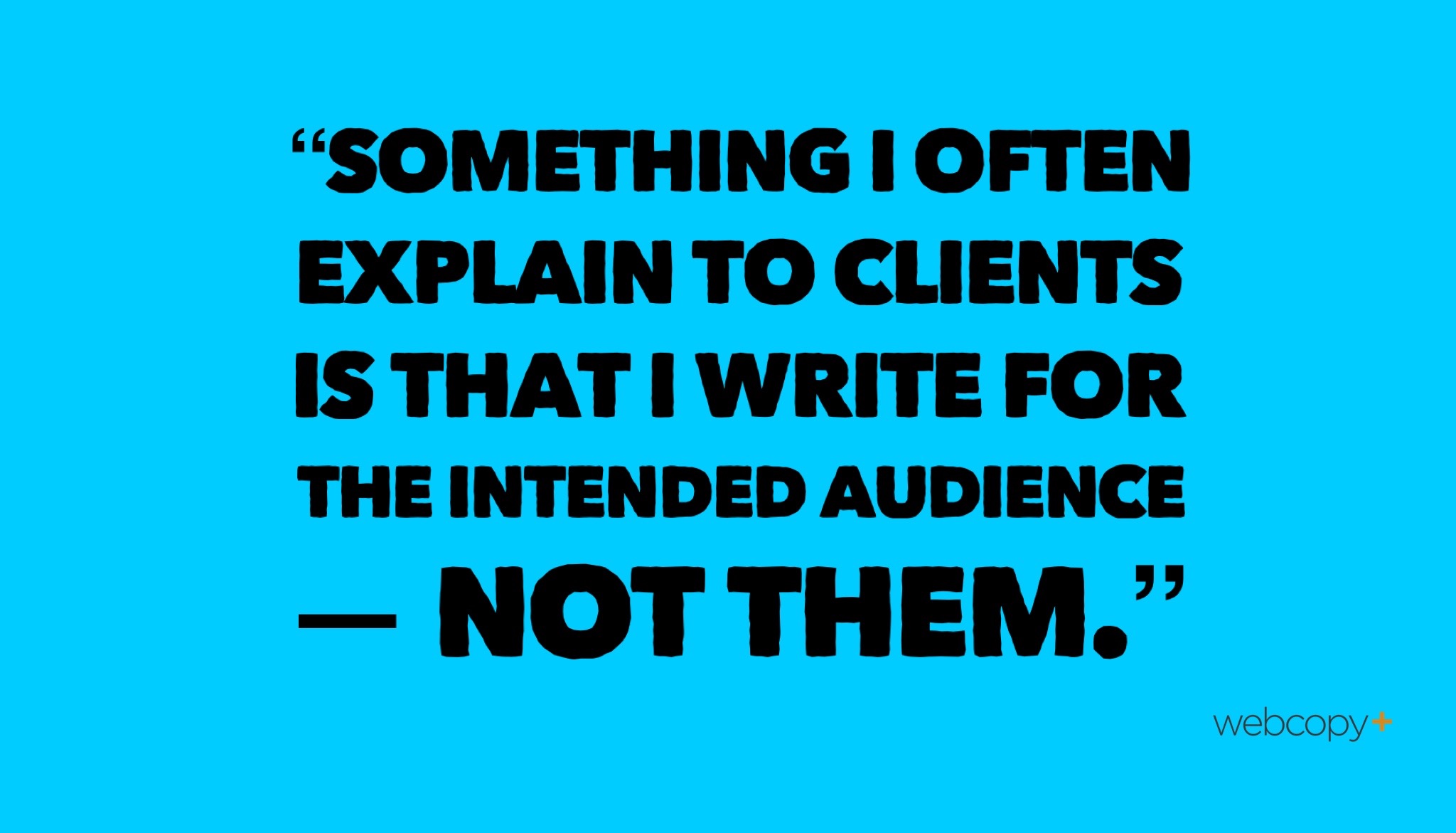
Whether you’re a content writer, designer, developer, photographer, artist — or virtually any creative — it seems we’ve all had experiences where clients unknowingly get in the way. Following a passing comment or a random article that pops up in a feed, suddenly the client starts to insist on ill-advised tactics. It can be a challenging situation, but one that can be resolved with the right approach.
Continue reading →
Posted on Feb 19 2019 4:48 am by Web Copywriters
tags: Working in the Web
|
category: Writing for the Web |
Leave a comment

Whether you’re marketing electronic gadgets B2C, or professional services B2B, you need to engage people emotionally to win their business. Why? As humans, we make decisions emotionally and rationalize them logically. As a result, a highly effective way to capture an individual’s heart is to focus on benefits.
Continue reading →
Posted on Feb 12 2019 12:10 pm by Rick Sloboda
|
category: Writing for the Web |
Leave a comment

Pay your children to read? I did it on a whim one evening and felt somewhat sheepish. Reading should be a natural pastime that you desire and enjoy, right? But then I was told something that made me realize it’s not only okay — it might be brilliant. Here’s why and how you should consider launching your own ‘book club for young entrepreneurs’ at home.
Continue reading →
Posted on Aug 31 2018 8:26 am by Rick Sloboda
|
category: Writing for the Web |
Leave a comment

You know your target audience. Your inbound marketing seems to be tracking well. Why bother with buyer personas? The reasoning is similar to why you need web content writers (see what we did there?): To really optimize your content marketing.
Continue reading →
Posted on Feb 27 2018 8:23 am by Rick Sloboda
tags: Web Content Strategy
|
category: Writing for the Web |
Leave a comment