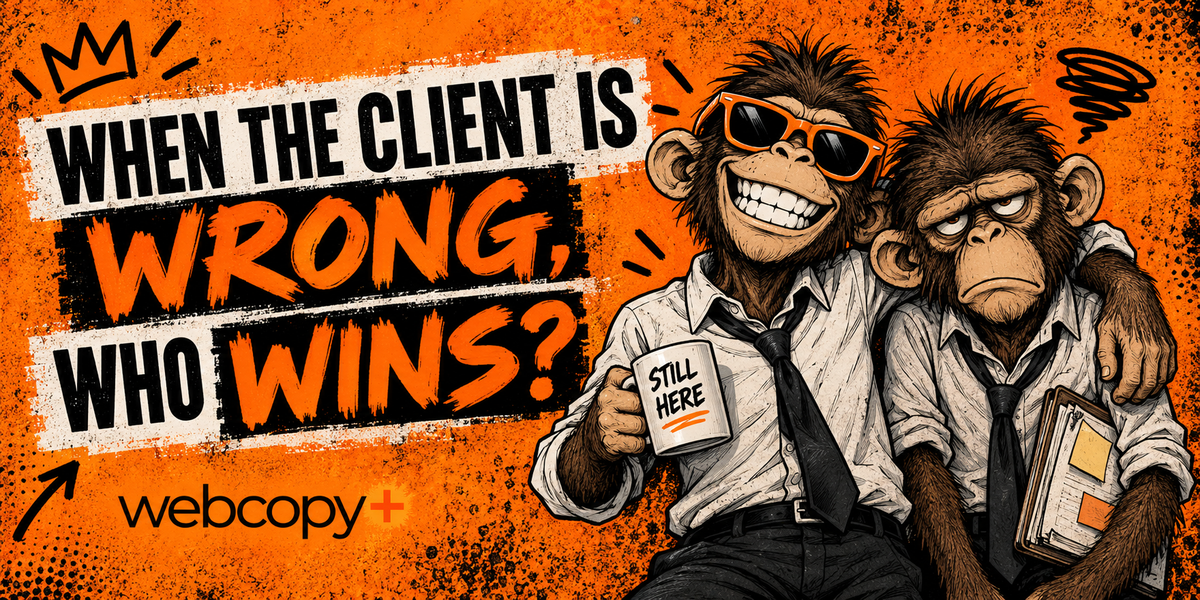
Probably nobody.
That may be the first mistake we make when creative work starts going sideways: assuming there has to be a winner.
The designer has expertise. The client knows the business. Both have opinions. Both can also be wrong.
And somewhere outside the meeting is the person neither side should forget: the customer.
So when a client insists on a design decision you believe will hurt the work, the useful question isn’t really, “Who wins?”
It’s: What does the work need?
CHECK YOUR EGO BEFORE YOU CHECK THE CLIENT
Anna Barton, Designer & Art Director, was refreshingly candid about what happens when a client pushes back.
“Once I get over the jolt of shock (mostly an injured ego), I re-assess their feedback, put myself into their headspace, and really try to understand where the comments stem from.”
That “injured ego” part matters.
Creative work is personal enough that it’s easy to confuse defending the idea with defending yourself.
Anna says that, looking back, client feedback has often exposed a business need she hadn’t given enough weight to. The rethink improved the work.
That doesn’t mean she rolls over.
She’ll make the case for a concept. She’ll explain the rationale. She’ll push when she believes something important is at stake. But she no longer sees every disagreement as something to win.
Earlier in her career, she admits she was more likely to view the designer as the enlightened one and the client as someone who needed educating. Experience changed that.
Now, the relationship matters just as much as the argument.
As Anna puts it:
“I’m a designer, not a fighter.”
There’s still a line. If the client wants something purposeless, off-brand or fundamentally at odds with the brief, she’d rather suggest another designer than keep forcing the relationship.
That’s not giving up.
That’s knowing when the partnership itself has become the problem.
TAKE OPINION OUT OF THE ROOM
Arley McBlain approaches the same problem from a different angle. You can also find him on LinkedIn.
When he and a client disagree, he tries to move the conversation away from personal preference and back to the audience.
“I always begin trying to guide the work in the context of putting the audience first.”
“I like this.”
“I don’t like this.”
“This feels better.”
None of those tells us much.
What does the audience understand?
What do they miss?
What helps them act?
When opinion still collides with opinion, Arley has sometimes used a basic user test with people at hand.
Now there’s something more useful in the room than two competing viewpoints.
The designer isn’t trying to beat the client. The client isn’t being asked to surrender to the designer. Both are looking at the work through the eyes of the people it’s supposed to serve.
Of course, that doesn’t solve everything.
Sometimes the client simply wants what they want.
Arley remembers the words of his first art director:
“On this one you’re just a pair of hands.”
There’s some wisdom in that too.
Not every disagreement deserves a crusade.
REMEMBER WHAT YOU’RE ACTUALLY BEING PAID FOR
Bernard B. Clairmont IV, Graphic Designer at BC Designs, sees pushback as part of the job.
If a client is paying for your expertise, you have a responsibility to explain when you believe a decision will hurt the outcome.
That doesn’t mean, “I’m the designer, therefore I’m right.”
It means you shouldn’t quietly execute something you believe is going to fail just because the conversation is uncomfortable.
Bernard’s fallback is wonderfully simple:
“Let me make you money.”
That gets to the heart of it.
The point of the work usually isn’t to prove the designer has better taste.
It isn’t to make the client feel right either.
The point is to help the business communicate clearly, build trust, differentiate itself and get people to act.
Once you bring the conversation back to the result, a lot of creative disagreement becomes easier to sort out.
THE CLIENT MAY BE WRONG. SO MAY YOU.
That’s probably the part worth remembering.
The client can absolutely be wrong.
So can the designer.
The real skill is figuring out what kind of disagreement you’re having.
Is the client revealing something about the business you didn’t understand?
Are you protecting an important design principle?
Is one of you simply attached to an idea?
Can you test it?
Does the decision actually hurt the outcome, or does it just offend your taste?
And if the client still wants to go the other way after you’ve made the case, is it worth continuing the fight?
That’s where judgment matters: knowing when to push, when to compromise, and when the disagreement simply isn’t important enough to keep feeding.
The best creative relationships probably never become designer versus client in the first place. That’s especially true when agencies bring in specialist content support early.
Both sides should be on the same side of the table, looking at the problem.
And if somebody has to win, it should probably be the person the work was created for.
By Rick Sloboda, founder of Webcopy+ and website content strategist.
Is your website helping customers see your value, or making you look like everyone else? Let’s sharpen the positioning and make the message work harder.




Egos always seem to get in the way of getting things right. Whether it’s design, development, or content writing, do what’s best for the audience.
Exactly, Steven — it’s the best choice. Cater to the audience and they’ll reward the client’s bottom line. :)
You can win the battle with a client, but in the end you lose.