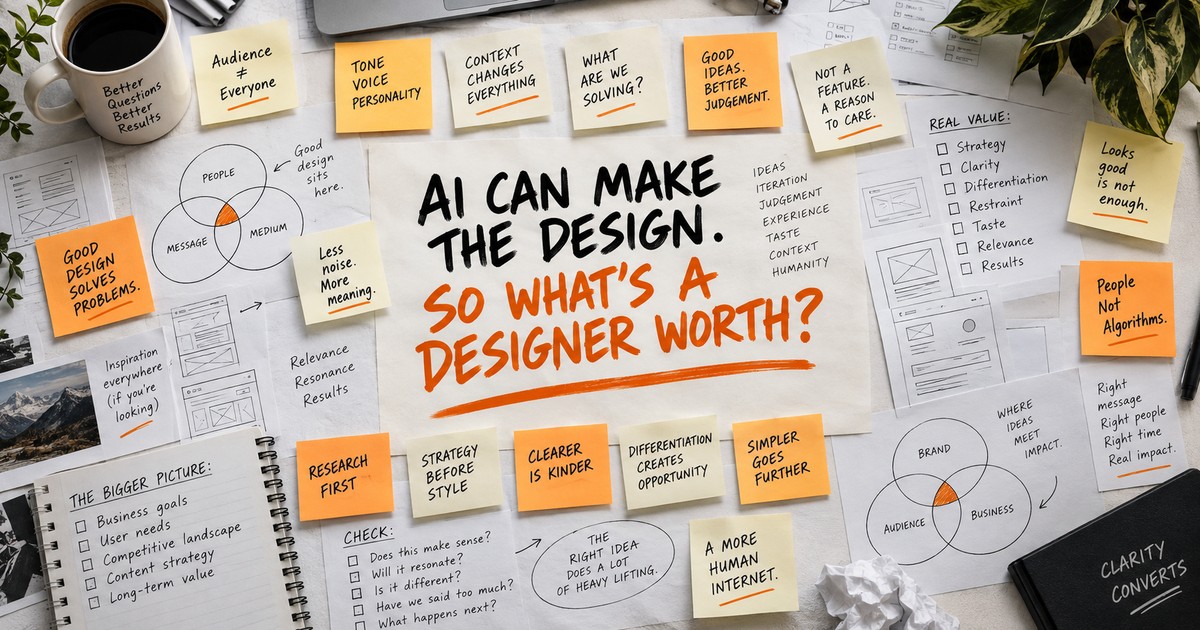
AI can produce a logo, generate a layout, build a prototype, create imagery and increasingly turn an idea into a functioning website.
That changes the economics of design. It does not necessarily reduce the value of designers. It may be clarifying where their value was all along.
I’ve worked with hundreds of designers over the years, and the best ones were never valuable simply because they knew how to make something look good. They saw things other people missed. They challenged assumptions, simplified complexity, caught inconsistencies, understood hierarchy and behaviour, and knew when an idea needed another hour of work or needed to be killed altogether.
AI is automating more of the execution. The harder part is deciding what deserves to be executed in the first place.
AI IS RAISING THE FLOOR
Brian Allen, Founder & Creative Director at Special Forces, describes AI as the first creative tool that can hand you something that looks competent on the first try.
Weak work used to reveal itself fairly quickly. A bad sketch looked unfinished. A clumsy layout felt amateur. Today an AI-generated concept can arrive polished, persuasive and apparently complete before anyone has asked whether the underlying idea is any good.
As Brian puts it:
“What it produces is a convincing illusion.”
The surface can look finished while the thinking underneath it is still half-baked. That shifts more value toward the person who can tell the difference between a convincing execution and a worthwhile idea.
Brian sees that value increasingly concentrated in “knowing what’s good. Taste. Context. What to simplify, what to challenge, what to kill before you go any further.”
AI can produce ten plausible directions before lunch. Choosing the one worth pursuing, or recognizing that none of them is, may be the more valuable decision.
JUDGMENT STARTS BEFORE THE DESIGN
Chad Borlase, Design & AI Transformation Leader, pushes the idea further.
Good judgment is not only about selecting among finished options. It begins earlier, with deciding whether the team is solving the right problem at all.
“What it still cannot produce is the idea that makes a product lovable, or the judgment to know what not to build, and when a client’s stated problem isn’t the real one.”
Clients do not always arrive with the right diagnosis.
They may ask for a new homepage when the problem is positioning. They may ask for another feature when customers are already overwhelmed. They may ask for a visual refresh when the underlying experience is confusing.
A designer who simply executes the request can create a beautiful answer to the wrong question.
That is why experienced designers often create value before they touch the design itself. They interrogate the brief, uncover assumptions, clarify the audience and sometimes tell a client that the thing they asked for is not the thing they actually need.
Chad argues that the goal should reach beyond a clean UX solution toward a deeper customer experience: an idea people connect with and remember.
AI makes iteration cheaper. Insight remains stubbornly expensive.
WHEN GOOD ENOUGH IS EVERYWHERE
There is another consequence of making competent creative work easier to produce: more people can generate more options, but those options may not become more distinctive.
A 2026 meta-analysis of 19 studies found a small but statistically significant homogenization effect in human-AI co-creation. In other words, people working with generative AI can improve their individual creative output while the collective pool of ideas becomes less diverse. The researchers stress that the effect is conditional, not inevitable, and varies by task and how the technology is used.
That is a more interesting problem than “AI makes bad design.”
AI can make pretty good design at enormous scale.
When thousands of people have access to the same models, patterns and shortcuts, “pretty good” becomes a crowded neighbourhood.
Microsoft researchers examining AI-assisted web creation found a similar risk in “vibe coding.” Their concern is that frictionless generation can pull creators toward familiar conventions simply because those are the easiest defaults to accept. They argue for introducing “productive friction”: moments that force people to question, compare and deliberately move away from the obvious answer.
That sounds a lot like what good designers have always done.
They make people stop, ask why and question the default. They notice when five polished options are really the same idea wearing different clothes.
If AI makes competence abundant, distinctiveness becomes harder to achieve.
DESIGN ALSO HAS TO UNDERSTAND WHAT PEOPLE FEEL
Shilpika, Business Growth Consultant at Marketing with Pika, brings another dimension into the discussion: human association, emotion and interpretation.
AI can already generate directions quickly and respond impressively to context. But design does not exist only in the context supplied to a model. It also exists inside the memories, biases, cultural associations and expectations carried by the person looking at it.
A colour can mean one thing in one setting and something very different in another. A shape can resemble something the creator never intended. A visual metaphor can seem clever to one audience and inappropriate to another.
Shilpika recently experienced a wonderfully mundane example.
She sketched a logo and had AI develop it. The system followed her direction almost perfectly, but produced a shape that looked unintentionally anatomical.
She noticed immediately. So did a designer friend.
The AI had followed the instruction and missed the implication.
That small example says a lot. Design is not simply the arrangement of visual components. It requires imagining the person on the other side of the work and anticipating what that person might notice, remember, misunderstand, associate or feel.
Research into AI-generated cultural imagery is beginning to probe the same territory. One 2026 Scientific Reports study examining AI-generated cultural heritage designs found that audience responses were shaped not only by aesthetics, but also by perceived authenticity, cultural identity and symbolic meaning.
Shilpika puts the human side of that neatly:
“That sensitivity to how another human might interpret, feel, or react to something is where I think the designer becomes even more valuable.”
That ability is easy to underestimate because it often appears as a simple reaction: something feels wrong.
But behind that reaction can be years of accumulated experience, cultural awareness and pattern recognition.
IMAGINATION IS MORE THAN PRODUCING OPTIONS
Shilpika also raises an important distinction between generating variations and making a conceptual leap.
She recalls hearing a University of Pennsylvania professor describe AI as a “coherence machine”: extraordinarily capable at producing plausible continuations and combinations, but not equivalent to human imagination or abductive reasoning.
Whether that distinction holds indefinitely is impossible to know. AI capabilities are moving too quickly for confident declarations about what machines will never do.
What matters now is that AI still benefits enormously from the quality of the direction, constraints, questions and imagination brought to it. Designers do not merely polish whatever a model generates. They can give the model somewhere more interesting to go.
The valuable prompt is rarely “make this prettier.”
It comes from someone who understands the business, audience, category, cultural context and underlying problem well enough to explore territory that a generic prompt would never reach.
THEN COMES THE UNCOMFORTABLE QUESTION
Brian raises what may be the hardest issue in the entire discussion:
“The hardest part is that we learned all that by doing the work AI now does. The big question is how will the next generation learn to develop this judgement?”
Expertise is usually built through thousands of small decisions, corrections, failures and repetitions. Junior designers learn hierarchy by building bad hierarchies. They learn restraint by overdesigning. They discover why one idea survives critique while another collapses. Senior designers review the work and gradually teach them to see what they could not see before.
So what happens when AI removes a large portion of that practice?
A 2026 MIT-led experiment involving 133 patent lawyers offers an intriguing parallel. Lawyers given an AI drafting assistant produced better work while using it. But after three months, when researchers tested professional judgment without AI, the lasting advantage was concentrated among senior lawyers. Junior lawyers showed no average improvement on that judgment test.
This was a legal study, not a design study. It does not prove the same thing is happening to junior designers.
But it raises a question creative industries should probably take seriously:
What happens when people can produce senior-looking work before they have developed senior judgment?
Chad argues that this makes mentoring more important, not less. AI may remove production time, but design leaders still need to create opportunities for younger designers to make decisions, receive critique, defend choices and understand why one direction is better than another.
We may be automating part of the traditional apprenticeship. If so, the profession will have to invent a better one.
MAYBE AI WILL FINALLY PROVE WHAT DESIGNERS WERE WORTH
For years, designers have occasionally had to defend themselves against the idea that design is mostly aesthetic production: make the logo, lay out the page, choose the type, make it look better.
AI may end up demolishing that misconception more effectively than designers ever could.
Once almost anyone can generate something polished, polish stops being convincing evidence of expertise.
The value moves into the decisions underneath it: identifying the real problem, knowing what belongs and what doesn’t, understanding what an audience will notice and feel, finding something a brand can credibly own, rejecting the generic and deciding what should never have been built at all.
After working alongside hundreds of designers, I don’t see AI exposing how little designers are worth.
I see it exposing how much of their worth was never in the software.
AI is becoming astonishingly good at generating answers.
The advantage may increasingly belong to the people who know which questions are worth asking.

By Rick Sloboda
Founder & Chief Content Strategist, Webcopy+



Interesting read. It seems the bottom line is good designers still have an important role to play, more on the strategic level. And that the rest of us will make good looking crap. 😏
LOL — that’s a pretty good summary. 😏 AI can get more people to “looks good” very quickly. But strategy, judgment and knowing what actually deserves to exist are still where good designers earn their keep.
Design used to be thoughtful. Now design is fast and careless.