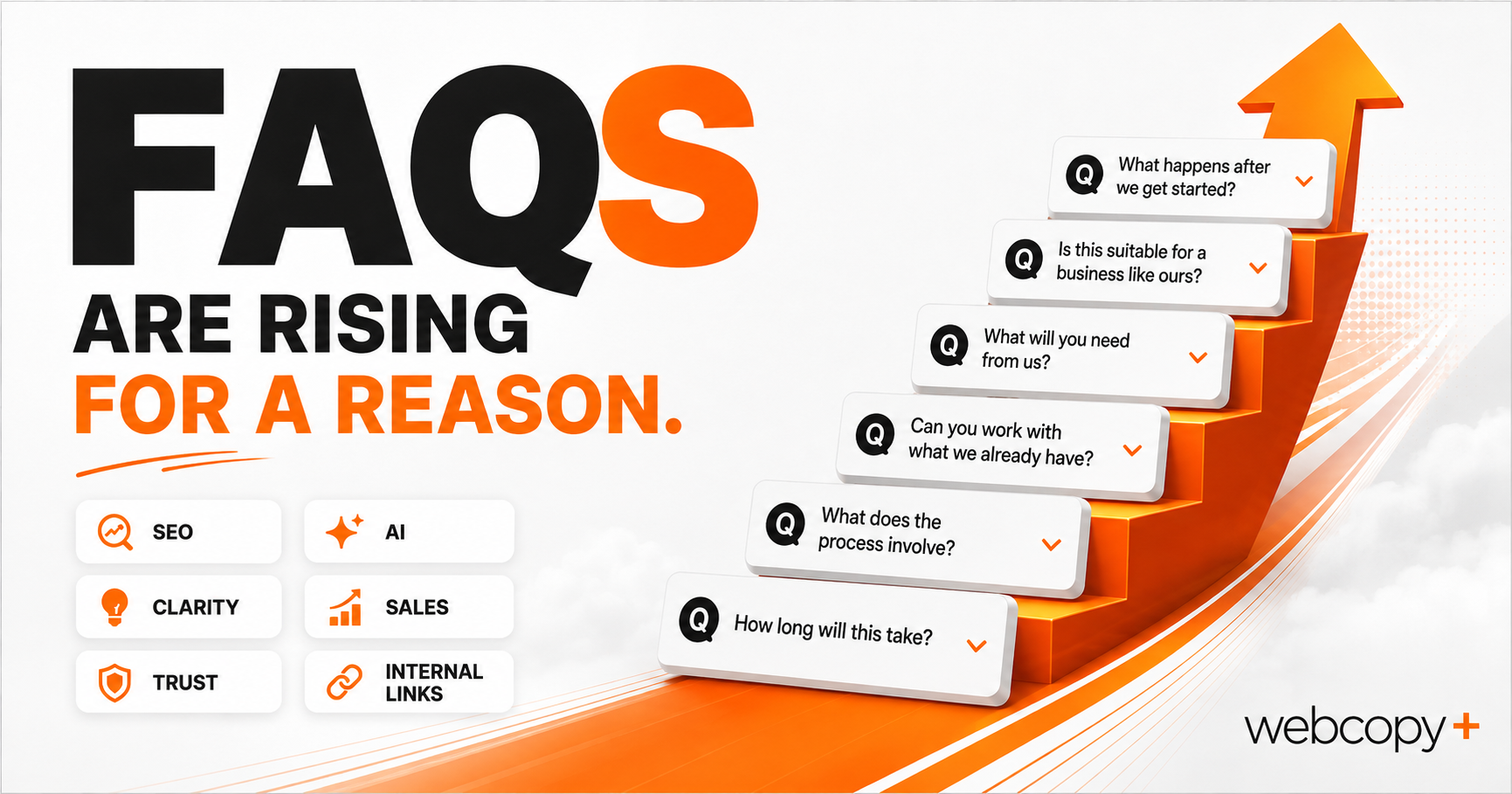
Lately, more agencies have been asking us to refine, expand or rebuild their clients’ FAQ sections.
Not because FAQs suddenly became glamorous.
Nobody is gathering around a boardroom table saying, “Forget the homepage. Let’s make the FAQs pop!”
But they are getting more attention because a strong FAQ section can do several jobs at once. It can support search visibility, help AI systems understand a business, answer sales objections, strengthen internal linking and prevent service pages from buckling under every possible detail.
That is a lot of useful work for a section once treated as the website’s miscellaneous drawer.
AEO HAS PUT FAQS BACK ON THE RADAR
Answer Engine Optimization, or AEO, is one reason for the renewed interest.
Search is changing. People increasingly ask complete questions, while search engines and AI systems try to deliver useful answers without sending them on a digital scavenger hunt.
Clear question-and-answer content can help.
This is also where the conversation tends to drift into fog-machine territory.
There is no secret FAQ formula that guarantees ChatGPT, Google or any other platform will quote your website. Adding question marks to a page does not magically turn it into an authority.
The fundamentals still matter:
- Answer real questions
- Give the useful information early
- Include original details competitors cannot easily copy
- Organize the page clearly
- Link to deeper information when it helps
In other words, write for people in a way machines can understand.
Not as exciting as an AEO cheat code, but far more useful.
THE BEST FAQ QUESTIONS ALREADY EXIST
Businesses often struggle to decide what belongs in an FAQ section.
The good news is that the questions are probably already sitting in the inbox.
Look at sales emails, consultation notes, contact forms, customer service conversations and the questions people ask just before making a decision.
Those are your FAQs.
Not:
Why is our company the perfect choice?
Nobody asked that.
The best questions usually reveal hesitation:
- How long will this take?
- What does the process involve?
- Can you work with what we already have?
- What will you need from us?
- Is this suitable for a business like ours?
- What happens after we get started?
A useful rule of thumb: when your team repeatedly answers the same question, your website should probably answer it too.
ANSWER FIRST. EXPLAIN SECOND.
Many FAQ answers begin with a warm-up lap.
They establish context, introduce a philosophy and clear their throat for 120 words before finally reaching the point.
Readers should not need excavation equipment.
Give the direct answer first. Then add whatever context, qualifications or examples make it useful.
For example:
Can existing website content be improved, or does it need to be rewritten?
Weak:
Every website is unique, and there are several factors to consider when evaluating existing content.
Stronger:
Existing website content can often be improved rather than completely rewritten, provided the structure, messaging and source material are still sound.
The second version respects the question.
It also makes the answer easier for search engines and AI systems to interpret because the useful information is not buried beneath a ceremonial introduction.
MAKE EVERY ANSWER EARN ITS SPACE
Generic FAQ answers can be worse than no answer at all.
Consider:
How long does the process take?
Timelines vary depending on the project.
Technically accurate. Practically useless.
A stronger answer gives the visitor something to work with:
Most projects take four to six weeks from discovery to final delivery, although larger websites or projects involving several stakeholders may require more time.
Specificity builds trust.
It also gives search engines and AI systems information worth surfacing.
Strong FAQ answers often include one detail competitors leave out:
- A realistic timeframe
- A typical range
- A clear limitation
- A step in the process
- A common mistake
- A practical example
- A useful decision rule
That is where an FAQ moves from filler to expertise.
FAQS SHOULD LEAD SOMEWHERE
A common mistake is treating each FAQ answer as a sealed container.
Question. Answer. Next question.
A stronger FAQ section helps visitors continue their journey.
A concise answer can link to a relevant service page, detailed guide, case study, process page or related FAQ. When the natural next step is a conversation, it can point there too.
This works especially well when a website has both a central FAQ hub and deeper supporting pages.
The hub provides the quick answer. The detailed page handles the nuances.
Think of the FAQ section as a switchboard, not a cul-de-sac.
It should answer the immediate question, then connect visitors to the next useful piece of information.
FAQS CAN KEEP SERVICE PAGES FOCUSED
Service pages tend to swell because everyone has one more clarification to add.
Sales wants pricing context.
Operations wants process details.
Legal wants qualifications.
Someone remembers a question from 2019 and insists it deserves three paragraphs, a pie chart and a downloadable PDF.
Soon the page is trying to sell the service, explain every possible scenario and negotiate a peace treaty.
A well-planned FAQ section gives secondary information a sensible home.
The service page can stay focused on the essentials:
- What the service is
- Who it is for
- Why it matters
- Why the company is qualified
- What the visitor should do next
The FAQ handles the supporting questions without turning the main page into a filing cabinet.
GOOD FAQS CAN IMPROVE LEAD QUALITY
A strong FAQ section should not merely generate more inquiries.
It can help generate better ones.
When people understand the process, timing, expectations and fit before contacting a company, they arrive with fewer surprises and more informed questions.
That saves time on both sides.
It can also quietly discourage poor-fit inquiries.
That is not a flaw.
A website should not persuade everyone to get in touch. It should help the right people move forward and give everyone else enough information to recognize a mismatch.
Clarity converts, but it also qualifies.
THE PAGE NEEDS AN OWNER
FAQ sections age quietly.
Processes change. Services evolve. Pricing models shift. Links break. Answers written three years ago continue nodding confidently from the page.
Someone should own the section.
Review it regularly. Remove questions that no longer matter. Add new ones based on actual customer conversations. Check that every link still goes somewhere useful.
An author or reviewer line can also add accountability:
Answers by [Name], drawing on [relevant experience]. Reviewed [Month Year].
It tells readers who stands behind the information and signals that the page has not been left to fossilize.
MORE QUESTIONS ARE NOT ALWAYS BETTER
Expanding an FAQ section does not mean turning it into an interrogation transcript.
Twenty sharp questions beat 60 flimsy ones.
Remove anything that:
- Repeats information already answered nearby
- Exists mainly to deliver a sales pitch
- Uses language customers would never use
- Produces an answer too vague to help
- Belongs on another page
- Has not been relevant in years
The goal is not volume.
It is usefulness.
FAQS ARE BECOMING PART OF THE STRATEGY
The agencies asking us to expand their clients’ FAQ sections are not doing it because FAQs are fashionable.
They are doing it because a thoughtful FAQ section can be an important part of a broader content strategy, making a website easier to find, understand and act on
It can support AEO without sounding robotic.
It can reduce hesitation without oversimplifying the service.
It can strengthen other pages without making them longer.
And it can answer the questions standing between a visitor and a decision.
That is quite a promotion for a section once treated as a random grab bag for whatever information did not fit anywhere else.

By Rick Sloboda, founder of Webcopy+ and a website content strategist helping businesses turn clearer messaging into better results since 2006.
Need sharper answers and a stronger website message? Let’s chat.



Yeah, turns out FAQs are one of the most important influencers for AEO. Best to keep the language formal/professional.