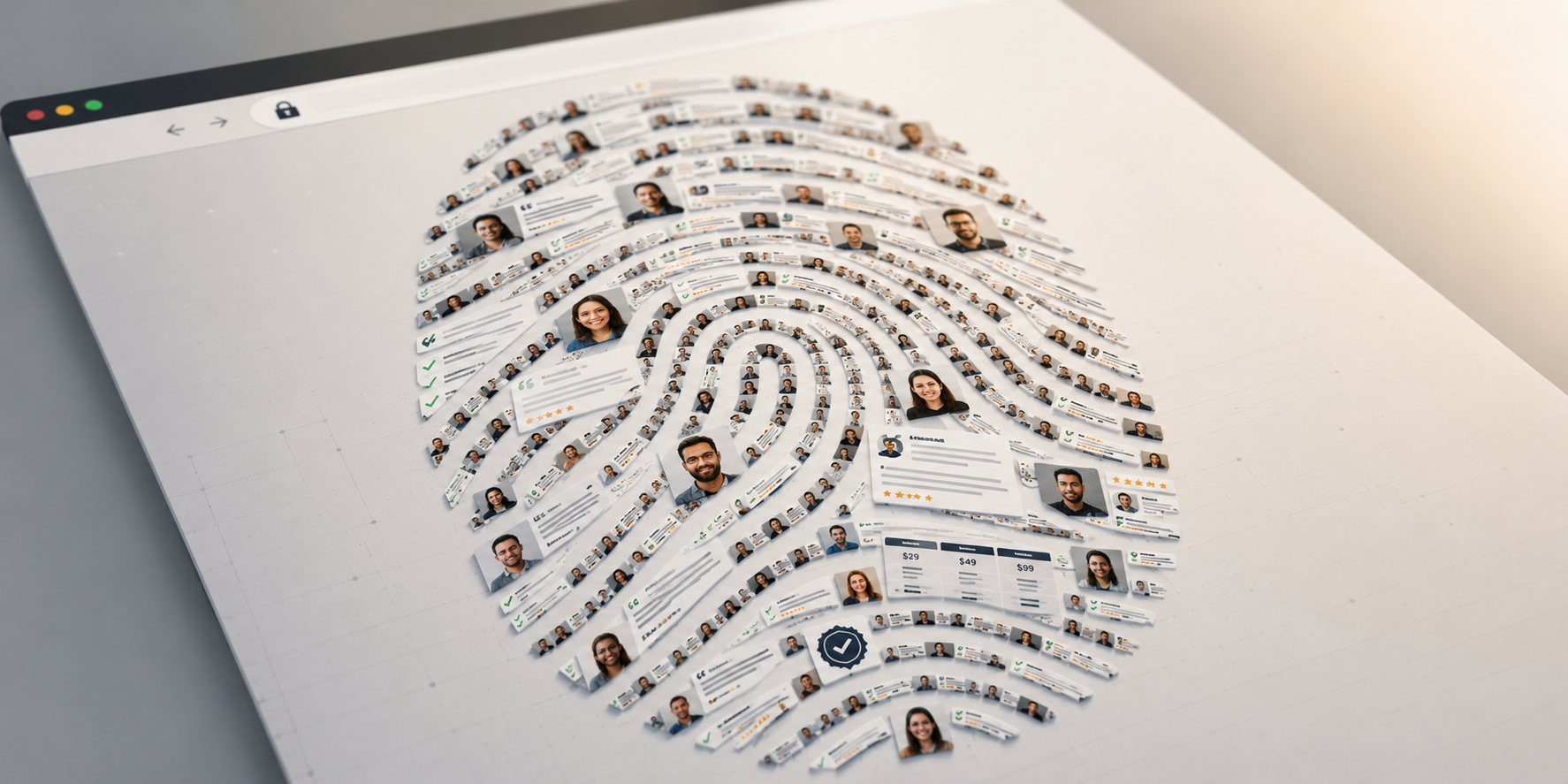
Polish used to help a business look credible. AI has made polish abundant.
Almost any company can now produce a smooth home page filled with confident claims, clean grammar and agreeable ideas before lunch. The trouble is that polished content can still feel strangely empty. It may say all the right things without showing why this particular business understands the customer, deserves to be believed or will stand behind the result.
According to a YouGov survey commissioned by Pangram, 69% of people who consume online content trust AI-generated content less than human-generated content.
The point is not whether visitors can detect AI. Most are not inspecting punctuation or studying sentence patterns for machine fingerprints.
The problem is that generic content removes many of the signals people use to judge credibility: specific knowledge, visible expertise, honest answers, meaningful proof and accountable people.
Trust has to be shown.
START BY MAKING PEOPLE FEEL UNDERSTOOD
Michael Harris, Founder and CEO of Storibot.ai, has a memorable name for content that sounds polished but says very little: “Bionic Slop.”
“Content that talks brilliantly while saying nothing.”
Plenty of business websites suffer from the same condition. They say a great deal about quality, service and commitment without giving visitors anything concrete to remember or believe.
Michael recommends a more useful starting point:
“The solution is one move: redesign your site with your customer as the hero and your business as the guide.”
This advice is sometimes reduced to a copywriting trick: use “you” more often than “we.” That misses the point.
Making the customer the hero means demonstrating that you understand the situation that brought them to your website.
What are they trying to accomplish? What is frustrating them? What have they already tried? What uncertainty is keeping them from moving forward?
Compare this:
We provide innovative, customer-focused solutions tailored to the unique needs of every client.
With this:
Your business has outgrown the patchwork of systems that got it this far. We help you replace them without disrupting the work your customers depend on.
The first statement could appear on thousands of websites. The second describes a recognizable problem.
Before visitors trust your solution, they need to trust that you understand the problem.
SHOW WHO IS MAKING THE PROMISE
Companies frequently claim that relationships set them apart, then hide everyone behind a stock photograph and a contact form.
Brandon C. Elliot, Creative Director at Brand One Media, sees a growing appetite for visible proof of human involvement.
“In today’s AI-everywhere-everything world it’s hard to find real human-driven content.”
He recommends an About page featuring staff with well-lit professional headshots, no AI retouching and biographies that sound as though actual people wrote them. He even imagines websites eventually carrying “a ‘Verisign’ against AI.”
Catharine Bradbury, CGD, Founder/CEO of Bradbury Brand + Design Experts, makes a similarly practical recommendation:
“I think all team members should have bios. So many now just show their position and a photo.”
For a small professional firm, that may mean introducing the entire team. For a larger organization, it could mean profiling the leaders, specialists and customer-facing people visitors are most likely to encounter.
A useful biography should answer three questions:
What does this person actually do?
What experience or perspective do they bring?
What can a client expect from them?
“Jennifer is our Director of Client Success” is a label.
“Jennifer has spent 14 years rescuing complex projects and is usually the first person clients call when plans change unexpectedly” gives us expertise, character and a reason to feel reassured.
Skip the manufactured quirks. Not every executive needs to announce a love of coffee, travel and spending time with family.
The goal is not to make everyone sound charming. It is to make the people behind the work visible and accountable.
TURN CLAIMS INTO EVIDENCE
Most websites try to create trust by describing the business.
Experienced. Responsive. Transparent. Innovative. Results-driven.
These words are not necessarily false. They are simply unsupported.
A useful editing exercise is to underline every positive claim on your website and ask:
What would prove this?
“We provide responsive service” becomes:
Every client email receives a reply within one business day.
“We have extensive industry experience” becomes:
Our senior team has completed more than 400 healthcare projects over the past 18 years.
“We believe in transparency” becomes:
Before work begins, you will receive the complete scope, schedule and price, including anything that could increase the cost.
The proof does more than make the claim credible. It gives the reader useful information.
The same test applies to testimonials and case studies. “They were wonderful to work with” is pleasant, but weak. A stronger testimonial explains what changed, which problem was solved or why the experience was better than expected.
A worthwhile case study should reveal the original problem, the choices considered, the reasoning behind the chosen approach and the outcome. Include a complication or limitation when it helps readers understand the work.
Perfect stories often feel manufactured. Specific stories feel lived.
MAKE YOUR VALUES COST SOMETHING
Catharine also recommends putting the brand story closer to the front of the website:
“Have your brand story on your home page. Having this front and centre helps build credibility and establishes you as a human being.”
That does not mean every home page needs a company timeline beginning with a childhood dream and ending with a recent industry award.
The useful part of a brand story is the belief behind the business.
What did the founders notice that others had accepted? What frustrated them enough to build something different? What principle still influences how the company operates?
The same applies to brand values. Integrity, innovation, quality and customer care do not build trust simply because they appear beside attractive icons.
Values only become interesting when they cost the business something, change a decision or improve the customer’s experience.
If transparency matters, publish your pricing or explain what can change it.
If customer care matters, state how quickly people will receive a response and what happens when something goes wrong.
If quality matters, explain the standards, reviews or safeguards built into the process.
If innovation matters, identify what you do differently and why it produces a better result.
A value is not what a company claims to admire. It is what the company is willing to do because of it.
ANSWER THE QUESTIONS PEOPLE ACTUALLY HAVE
Ernest von Rosen, M.Sc., President of AMGmedia Works Inc., says the goal is “ultimately being able to reliably answer people’s questions and concerns, when they come to your site.”
It sounds obvious. Yet many websites are packed with what the company wants to announce and strangely silent about what customers want to know.
How much will this cost?
How long will it take?
Who will do the work?
What happens after I make contact?
What is included?
What could delay the project?
Who is this service not right for?
Businesses sometimes avoid direct answers because they might discourage a prospective customer.
That can be useful.
A strong content strategy should not persuade every visitor to contact you. It should help suitable customers make an informed decision and allow unsuitable ones to recognize the mismatch before both sides waste time.
Answering difficult questions also signals confidence. Businesses that understand their work can usually explain their process, pricing, limitations and risks without retreating into fog.
Candour might cost an inquiry. It can also earn a customer.
KEEP THE HUMAN VOICE WHEN THINGS GET AWKWARD
Ernest also points to the importance of “having a consistent ‘voice’ and genuine compassion for the website visitor, in all that you communicate.”
The final part matters: in all that you communicate.
Many companies sound warm and approachable on the home page, then become cold and bureaucratic in their policies, forms, error messages and support content.
That is where the real voice of the business often reveals itself.
Does the company explain difficult ideas plainly or hide behind jargon?
Does it acknowledge reasonable concerns or glide past them?
Does it remain helpful when someone needs support, wants to cancel or has made a mistake?
A human voice is not created by adding jokes or making every button clever. It comes from communicating with clarity, consistency and respect, especially when the subject is inconvenient.
Read your home page, pricing page, contact form, FAQs and cancellation policy in one sitting. They should feel as though the same company wrote all five.
CONDUCT A 15-MINUTE TRUST AUDIT
Choose one important page on your website and ask:
Does it describe the customer’s situation specifically enough to make them feel understood?
Which claims rely on adjectives when they could be supported with facts, examples or policies?
Can visitors see who has the experience and responsibility to deliver what is being promised?
Which useful question are we avoiding because the answer may discourage someone?
Could a competitor publish most of this page without changing it?
Fixing those five issues will do more for trust than adding another paragraph about passion, innovation or excellence.
TRUST LEAVES EVIDENCE
A trustworthy website does not need to look homemade or promise that AI never came near it.
It needs to contain evidence of care.
The customer’s situation is understood. Real people are visible. Claims are supported. Values influence decisions. Useful questions receive direct answers. The business communicates with the same clarity when helping someone as it does when selling to them.
AI can assist with research, drafting, organization and editing. The problem begins when convenience replaces thought and the business publishes material no knowledgeable person has shaped, challenged or accepted responsibility for.
People do not need your website to prove it was created without AI.
They need it to prove that knowledgeable people understand their problem, can support their claims and will stand behind the result.

What’s your take? What makes a website feel trustworthy to you, and what sends you reaching for the back button?


Funny, the contributors seem to hammer away at basics we should all know, but somehow overlook.
AI can create endless content, but if there’s no strategy behind it, it’s like the designer said ‘bionic slop’…and who needs or wants that? Nobody.
Indeed, Don — we all need reminders sometimes to get back to the basics! :)
Exactly, Angie. We’re already inundated with useless information, so who needs more ‘bionic slop’? As business coach Mark Wardell says, there are a million things we could do, but we need to choose the ones that serve a purpose.