A producer recently listened to a vocal I was working on with a Swedish singer and asked me a question I wasn’t expecting:
Is it AI?
It wasn’t.
The singer was completely real. But something about the production made the performance feel a little too polished, enough that another human wondered whether a machine was behind it.
His suggestion wasn’t to add anything. It was to take some production away so we could hear more of the singer: the breath, the texture, the little irregularities that happen when an actual person sings.
We’ve reached an interesting point when something made by a human can feel artificial because it sounds too perfect.
Design appears to be having a similar moment.
Canva has called 2026 the year of “Imperfect by Design,” pointing to growing interest in tactile textures, rougher visuals, DIY aesthetics and work that feels personal rather than relentlessly polished. Searches on its platform for DIY and scrapbook-style elements are up 90% year over year.
That doesn’t mean good design is getting uglier.
It may mean our idea of what feels authentic is changing.
WHEN POLISH BECOMES ABUNDANT
For most of modern commercial design, polish carried value because polish required skill, time and money.
Now a certain level of slick execution can be produced almost instantly.
That doesn’t make AI flawless. Anyone who uses it regularly knows it can generate clichés, bad decisions and beautifully rendered nonsense. What it has done is make competent execution dramatically faster and more accessible.
Canva’s 2026 global research found that 97% of marketing leaders already use AI in their daily creative work. Yet 87% of consumers still believe the best advertising requires a human touch, while 70% say they can usually recognize AI-generated ads because something feels missing.
Christopher Williams of Rucsak sees something even more fundamental happening.
“It’s not exactly a race to the bottom, but rather a race to the middle.”
As more AI-generated work becomes reference material and inspiration for still more AI-generated work, Christopher worries about creative output gradually folding back onto itself.
His response isn’t to reject technology. It’s to rediscover ways of making things that resist sameness: linocut, pen and ink, painting, carving, sculpture and other processes where the hand leaves evidence behind.
There’s research supporting the concern. A recent meta-analysis covering 19 studies and 61 effect sizes found a small but statistically significant homogenization effect in human-AI co-creation. Importantly, the researchers weren’t saying AI destroys creativity. Individual creative performance can improve while the collective output of many people becomes more similar. And that distinction matters.
AI can help us explore more possibilities. It can also make it easier for all of us to arrive at neighbouring answers.
WE’VE BEEN MANUFACTURING IMPERFECTION FOR YEARS
Of course, our attraction to imperfection is nothing new.
Years ago, I used to make rustic furniture for retailers. I manufactured the history.
I’d attack pieces with barbed wire, rusty nails, chicken wire and scraps of metal. I’d put wax between layers of paint so sections could later be sanded away in chunks. Sometimes I’d take a torch to the final finish. Tiny holes were made to resemble insect damage, then dirt was rubbed into them so they looked old.
The better I got at making new furniture look beaten up, the more authentic it appeared.
There’s something wonderfully ridiculous about that.
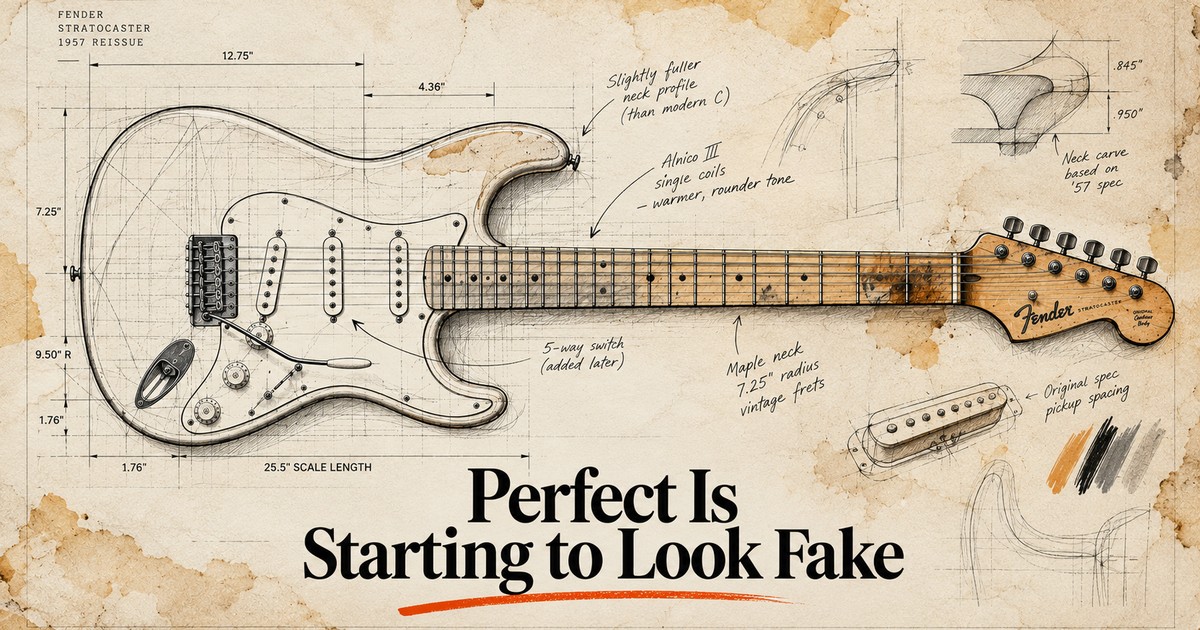
The guitar industry understands the attraction too. Fender’s Custom Shop sells new guitars intentionally aged to look as though they’ve spent decades being played in dive bars, rehearsal spaces and studios, with faded finishes, worn edges and carefully recreated scratches.
And those signs of simulated history aren’t treated as defects.
In Canada, 1957-style Fender Custom Shop Stratocasters can sell for roughly $6,700, with Heavy Relic versions topping $7,000. A production American Vintage II ’57 Stratocaster is roughly half that. The Custom Shop premium reflects far more than distressing, of course, including materials, components and craftsmanship. The point is that the simulated wear isn’t discounted as damage. It’s part of the desirability and charm.
People will pay serious money for a brand-new guitar that already looks like somebody dragged it through 1974.
I understand the appeal from another angle.
I own a Fender Custom Shop ’57 reissue. Mine isn’t distressed, but I paid a premium for it. I was told one technician worked on the guitar from start to finish rather than having it move anonymously down an assembly line.
I valued that.
I wasn’t only buying wood, pickups and specifications. Knowing someone had taken responsibility for the instrument throughout the process gave me a deeper connection to it. The care became part of the experience.
Researchers were documenting something similar years before generative AI arrived. A 2015 Journal of Marketing study found that consumers tended to value handmade products more highly partly because they perceived them as symbolically containing more “love.” The researchers tested that explanation against other factors including quality, uniqueness, effort and authenticity.
Maybe AI isn’t creating our desire for human connection.
Maybe it’s making that desire easier for us to notice.
MAYBE IMPERFECTION IS THE WRONG WORD
Chris Van Diepen challenged the premise in a way that gets closer to the real issue.
“Polish and human authorship are two different things.”
That’s important.
A weak design doesn’t become meaningful because the type is crooked. Adding paper grain, scratches and fake ink bleed to an AI-generated composition doesn’t make it human.
AI can fake roughness too.
Chris is more interested in imperfection as “the textural result of a human hand coming into organic contact with something.”
That creates a useful distinction.
Decorative imperfection is surface: scratches, grain, distressed lettering, rough textures and irregularities that can increasingly be summoned on command.
Process imperfection emerges because someone was genuinely making something: uneven pressure in ink, a chisel mark, a breath before a vocal, a decision made halfway through because the work itself suggested another direction.
And beneath both sits something more valuable than imperfection:
Judgment.
Why that mark? Why that word? Why leave the vocal crack instead of correcting it? Why break the grid there? Why stop?
The interesting thing about human creativity isn’t that people make mistakes. Machines can generate irregularities too.
It’s that a person can decide which ones belong.
SOMETIMES THE STORY CHANGES WHEN WE THINK AI WAS INVOLVED
This gets especially interesting in music.
A 2026 study involving 399 participants found that listeners imagined fewer and less engaging narratives when music was labelled as AI-generated, regardless of whether the music had actually been composed by AI or a human. Simply believing there was no human mind behind the music changed the listening experience.
Another 2026 experiment found that even listeners with formal musical training struggled to distinguish AI-generated, human-AI collaborative and human-composed music under blind conditions. More than half of the genuinely human-composed excerpts were misidentified.
Which brings me back to that Swedish singer.
The producer wasn’t reacting to AI.
He was reacting to what he thought AI sounded like.
The human performance was already there. We simply needed to let more of the person through.
That may increasingly apply to brands too.
THE ARGUMENT ISN’T HUMAN VERSUS AI
Christopher sees an opportunity for designers to reconnect with physical processes that became less common as creative work migrated onto screens.
Chris comes at the issue from another direction. He uses AI every day and considers it a valuable creative companion.
“I don’t think AI and heartfelt creative work are opposites.”
Beautiful work doesn’t suddenly become hollow because AI helped create it. Handmade work doesn’t automatically become meaningful because somebody got paint under their fingernails.
And deliberate imperfection can become every bit as formulaic as the polish it’s reacting against.
Chris argues that human authorship lives less in whether something looks polished or imperfect than in “the integrity of the choices and the process that make a piece feel whole and alive.”
That distinction matters well beyond design.
The same thing is happening with writing. The human alternative to AI-polished copy isn’t bad grammar and typos. It’s specificity, opinion, experience, taste and the quirky little observation another person wouldn’t have produced from the same generic prompt.
Maybe we don’t crave imperfection.
Maybe we crave evidence of care.
Someone made a choice instead of accepting the first plausible answer. Someone noticed that the vocal had become too polished. Someone decided where the furniture needed another scrape and where it didn’t. Someone stayed with the guitar from beginning to end.
AI will keep getting better at the surface. It can reproduce the scratch, the brushstroke, the distressed finish and the vocal breath. The visual and sonic cues we currently associate with human creation will become easier to manufacture too.
Which means fake imperfection won’t solve anything.
Perfect may be starting to look fake. But fake imperfection is still just another surface treatment. The real premium is the judgment and care behind the surface.

Rick Sloboda is the founder of Webcopy+, helping brands turn clearer thinking into stronger content.
Need sharper website content? Request a Free Content Audit



Leave a Reply