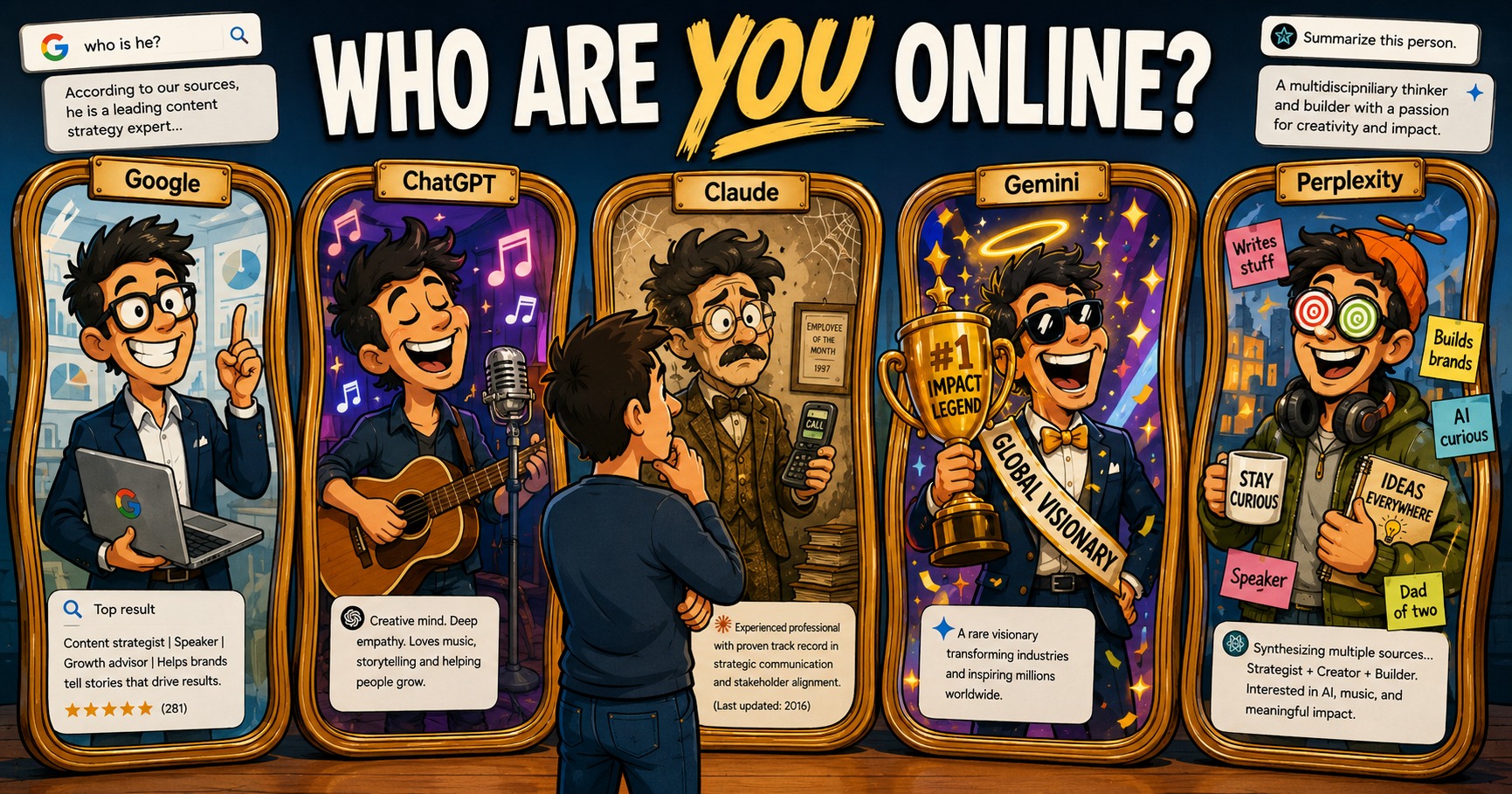
Most people know how they describe themselves.
That is not the same as knowing how the internet describes them.
A potential client may Google your name. An employer may scan LinkedIn. A new contact may ask ChatGPT, Claude, Gemini or Perplexity who you are before deciding whether you are worth a conversation.
By then, your online identity has already introduced itself.
The question is whether it introduced the right person.
I ASKED THE INTERNET WHO I WAS
I asked several friends and colleagues to search the same question across Google and leading AI platforms:
Who is Rick Sloboda?
The answers generally identified both sides of my professional life: founder of Webcopy+ and international songwriter.
Music usually received top billing.
That makes sense. I regularly release and promote songs, collaborate with artists around the world and repost thousands of reels featuring music I helped create.
My content strategy career has much deeper roots. The music side currently generates more visible activity.
The internet does not know which part of your work matters most to you.
It notices what keeps showing up.
That was the most useful finding from the experiment.
YOUR ONLINE IDENTITY IS ASSEMBLED
You can write the perfect bio and still be described differently elsewhere.
Your online identity is pieced together from your website, social profiles, interviews, directories, articles, reviews, media coverage and biographies you may have forgotten existed.
Some sources are current.
Some still list the title you used nine years ago and the city you left two moves back.
Old bios do not retire. They haunt.
A recent burst of activity can compete with decades of experience. A dated profile on a trusted website may carry more weight than a current bio buried somewhere obscure.
Your official description is what you publish.
Your online identity is what the internet keeps finding.
YOUR OWN SEARCH CAN FOOL YOU
Searching yourself is worthwhile, but it is not necessarily objective.
I see a version of this regularly with business owners. They Google their own products or services, see themselves ranking beautifully and assume customers must be seeing the same results.
Sometimes they are. Often, they are not.
Google may have noticed that they repeatedly visit the website, search the brand and click the listing. It may be serving them a personalized victory parade.
Location, account activity and previous behaviour can affect what appears. AI platforms may also draw on past conversations, saved preferences or account context.
The same issue applies when you search your own name. Asking your logged-in accounts who you are is a little like asking your mother to conduct the independent review.
For a clearer picture, run the stranger test.
Ask three people to search:
Who is [your name]?
Have them use Google and at least two AI platforms, then send screenshots.
Compare four things:
- What appears first?
- What is outdated?
- What is missing?
- Which sources keep resurfacing?
That will tell you more than an hour spent admiring your own search results.
AI HAS A COMPLIMENT PROBLEM
When an AI platform describes you, apply an extra filter.
Ask it a Grade 5 question and it may respond as though you have been shortlisted for the Nobel Prize in Curiosity.
The same instinct can creep into personal summaries.
Ordinary experience becomes a “remarkable multidisciplinary career.” Collaborate with two people overseas and AI has you personally reshaping global commerce.
Some praise may be deserved.
Some is verbal confetti.
Review every claim as one of four things:
- Fact
- Reasonable interpretation
- Outdated information
- Digital buttering
Facts can be verified. Interpretations require judgment. Outdated information needs attention.
Digital buttering belongs back in the tub.
YOU DO NOT NEED TO FIX THE ENTIRE INTERNET
Do not attempt to correct every forgotten profile, dead directory and biography written during the first Obama administration.
That path leads to madness and password-reset emails.
Focus on the sources that people and AI systems are most likely to find:
- Your website and About page
- LinkedIn and major professional profiles
- High-ranking interviews and contributor biographies
- Industry associations and trusted directories
- Current photographs
- Your title, company, location and core areas of expertise
Correct what is inaccurate. Clarify what is vague. Remove what no longer represents you when possible.
Then look at what is missing.
GIVE THE INTERNET BETTER MATERIAL
The most important lesson is not simply that you should write a better bio.
It is that you should create fresh evidence around the work you want associated with your name.
Publish useful articles. Share informed opinions. Update case studies. Contribute to credible publications. Keep important profiles current. Make sure your name is clearly connected to your present work.
In my case, the answer is not to quiet the music side.
It is to generate more visible, current material around website content strategy and the work Webcopy+ is doing now.
You cannot control every search result or AI summary.
But you can improve the ingredients.
You may write your own bio.
Increasingly, the internet writes one too.





LOL — I’ve seen that where people Google themselves and think they’re killing it on search results, only to learn that they’re nowhere to be seen. I’ll have to do my own test on AI! :P
Haha, exactly! The stranger test can be surprisingly revealing. Let me know what you find. :)
What people see and read as line is who you are to the outside world. So good to pay attention.
Absolutely. Our online presence often introduces us long before we get the chance.
In a way, for those online, what the web says about you is who you are. For good or bad.
Well said. 🙌 For many people, what the web shows them becomes the working version of who we are.